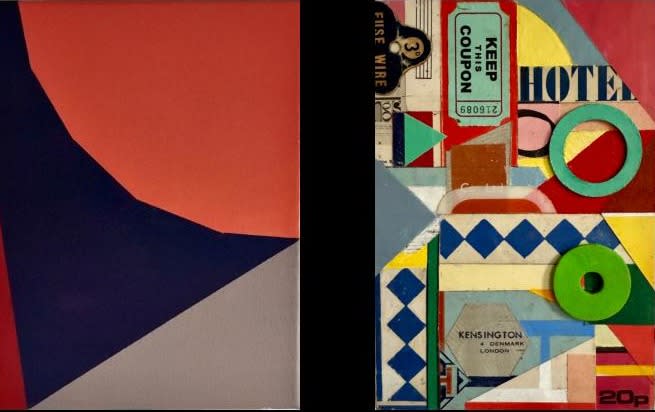
The Shape of Time brings together two artists who at first seem to have little in common. Lawrence Noga works with paint, collage and assemblage, often mixing all three. He uses found elements that look like tickets, flyers or labels taken from various sources, sometimes combined with fragments of unidentifiable objects, their now forgotten origins repurposed into art.
Sharon Hall’s work is uncompromisingly abstract although related to the observed world. She admits a fascination with watching the almost imperceptible movement of the shadows on her studio walls, slowly shifting and changing as the hours pass by. This affects perception of the wall itself and responding to this, her abstraction is not static and balanced. Areas of colour push against one another and are filled with an energy and internal tension. They carry an implication of potential movement and consequently, the passing of time.
The elements that Noga incorporates into his constructions were found in abandoned boxes stored in his late father’s garage. Inevitably, this also hints at the passing of time although in a very different way. His father’s old boxes provide the various bits and pieces he uses in his work and titles such as Arlington Street, The Embassy or Le Caprice hint at how places and events from different times can resonate within us today.
Similarly, the frescoed walls of the churches of Italy find echoes in the work of Sharon Hall who has recently been treating the surfaces of her works with an absorbent chalk-based ground, to make the colour more a part of the picture rather than sitting like a skin on top. She compares this to the appearance of a Renaissance fresco where the colours, having been applied while the plaster was still wet, were absorbed into the surface of the wall as they dried. Italian titles for her paintings such as Notte, Finestra or Senza Titola (Roma) hint that there might have been a specific source. Even though there is nothing that could be seen as a direct quotation, these paintings consequently carry an oblique connection to her Italian predecessors. Similarly, a painting like Japanese Fan carries a distant evocation of something that might exist in the real world.
There is something undoubtedly ‘Pop’ about Noga’s work and indeed, he confesses an admiration for artists like Eduardo Paolozzi or Peter Blake, early pioneers of the British Pop movement. The painted elements, made of brightly coloured and jagged geometrical shapes, flow together in syncopated rhythms, bringing a vibrant musical quality. Features such as solid black circles with a small central hole, evoke the discs of vinyl records while smaller circular features are like the knobs on a radio set. Areas with short repeated stripes become reminiscent of musical keyboards.
The abstract geometry of shifting shadows or the reusing of forgotten fragments might seem to have little in common but both artists, consciously or otherwise, can be thought of as dealing with one of the central mysteries of our existence, the shape of time.
Colin Wiggins