Andrew Hewish: STATION : A Journey through In-Between Spaces


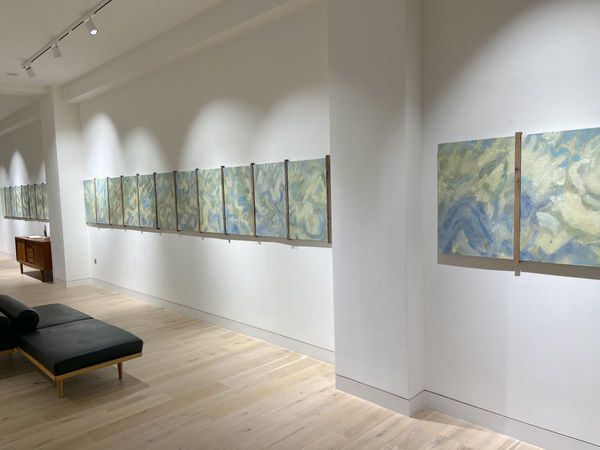
Vivienne Roberts Projects presents recent works by Andrew Hewish, including a 24 panel work, Station.
Hewish explores the state of the in-between, inspired by time spent on the Ligurian coast and a journey to Kyoto as experienced in the works of Hiroshige's Japanese woodblocks .
This exhibition continues Hewish's larger project of material and sensual exploration between the world of painting and lived experience.
Interview with Andrew Hewish:
Where did this exhibition begin?
In a monastery cove on the Ligurian coast only accessible by ferry. Rapallo - Santa Margherita - Portofino - San Fruttuoso. Comogli - Punta Chiappa. The ferry station names were incantatory.
What was that like?
The boat was an experience - spume, sky, rocks, rocking, waving. The splash drowning out the sound of sea birds. The sputter of the boat engine.
On arrival day trippers would fill the beach, then ebb away at twilight to nothing.Only the woman who throws firecrackers to stop the wild goats eating her herbs remained.
Like the lurch of an elevator, the Vaporetto in Venice, or the calm of the Mouettes in Lake Geneva - a rhythm of passage itself - wonder at being stationary inside the ferry. Arriving, the suspension of time gave way to being situated, to stillness.
There are a lot of different experiences here
I think of this as a positive collapse of experience, closer to how we actually live experience. I don't think we are as solid as we like to believe. This constant looping of experience is how we encounter and hold living and life. For me painting brings lived experience to the practice and history of painting in a vital entanglement. That experience of painting itself is always present in the studio. Could it be Berthe Morisot peeking through that panel, talking to Lee Krasner?
A recent trip to Kyoto is also here isn't it?
Yes, I spent a lot of time visiting temples and traditional architecture - looking at how Kyoto amplifies transitional spaces. The movement from one space to another becomes a meditation. From garden to verandah. From verandah to living space.
The fusama divides spaces, like the shoji screen it is a rectangle that can slide, articulate or hang in all sorts of ways to regulate space and light. Painting's rectangles dominate even in the floor where space is measured by the number of tatami matts it might contain.
In this exhibition the major work is STATION where wooden dividers embody passages from one part of the work to another and function as both the divider, the panel or the in-between space as punctuation between passages.
And the 53 Stations of the Tōkaidō?
Hiroshige's famous woodcut series is present here, The Tōkaidō is the coastal road from Tokyo to Kyoto, and Hiroshige created scenes based on each of the stations. The actual stations were official stopping off points along the road which regulated travellers' passage, but also functioned as points of rest. The presence of the architectonic as it is in Japanese houses regulates the experience of this work. The architectural elements of my work here revive a part of painting history - both in Japan and in the West - where paintings functioned and were developed as part of the architecture.
Why does STATION need twenty-four panels?
A question comes from the Enlightenment, when Roger de Piles suggests that we don't experience painting as a sequential work bit by bit, but that we can and do encounter it all at once. STATION plays with that as it is beyond the width of the visual field. Like walking meditations of the Romans, or large works by Barnett Newman. it is almost impossible to experience STATION in a single grab as the necessity of time, motion and space are amplified by the heartbeat of its scale.